There’s an urban legend about a famous author who goes to visit an English class. (I’ve heard this involving Robert Frost and William Faulkner.) The story goes that the English teacher goes on and on about how the blue curtains represent the character’s sadness and how they’re a metaphor for despair and how they connect with the rest of the novel’s characterizations. Finally the teacher asks the author about the creation of that metaphor. The author says, “I just liked blue.”
This has gone from a story that people tell at dinner parties to a meme that gets shared around social media:
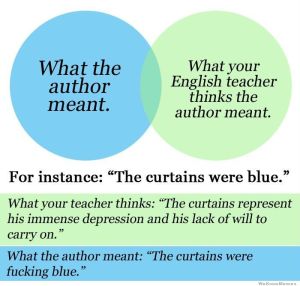
The suggestion is that English teachers are reading way too much into every little detail in a novel, even when the author didn’t intend that significance at all. Sometimes the curtains are just blue.
And that’s partly true. Not all details in a novel have the same level of significance. Not every single word is weighted with an intense emotional gravity.
But.
I can’t speak for every single writer, but even when I’m in the early drafting phases, I don’t choose words randomly. When I’m trying to decide what kind of music a character will be listening to or what kind of car they drive or what snack they’ll have, I go down serious research rabbit holes. My search history is basically all “most popular snack foods on Cape Cod” or “early 2000s car models, resale value.” And from there I try to find the option that would connect best with that particular character. Will these details even show up in a final draft? Who knows?! But they help me understand the character and their sense of place. Then, when I’m in the revising phase, the details get more concise and specific.
When you go through multiple rounds of your own revisions, then work on edits with an editor, go through copyedits and first pass pages, you look at the same words dozens of times. You scrutinize them. Even if blue curtains aren’t there because they’re a metaphor for the character’s sadness, they’re there for a reason. Maybe it’s because the character would have chosen blue curtains. Maybe they’re there because the author looked at an inspo board for this particular room and found one that had blue curtains. But if a detail is there, it’s because the author intended it. And that detail stayed there through all those rounds of writing and rewriting for a reason.
Of course, that doesn’t mean the professor in the aforementioned example is right. Not all interpretations are valid. You need to back up the ‘blue curtains are the character’s emotional turmoil’ theory with supporting examples from the text, maybe that blue is used throughout the novel when the character expresses sadness, like how oranges show up in the Godfather as a visual precursor to violence. (Fun fact: apparently the oranges were a more random production choice to try to ‘brighten up’ an otherwise more subdued set. But that brightening works well in contrast to the violence of the film and therefore stands out. So even though the choice might have been random, the staging and visual language of the film and the editing of shots supports this as a visual narrative tool for the viewer.) Readers need to make thoughtful assessments about particular details and how they’re used in a story. Not every assessment is valid or supported by the text. But that doesn’t mean the writer didn’t bring any intent into a particular detail.
These days, I’ve been thinking a lot about generative AI and how using AI for creative work diminishes our capacity for imagination and thought, and how casual readers are a lot more likely to look at the creation of a book as something that’s easy to do.
Writing takes work. It takes thought. It takes intent. Even if the blue curtains aren’t specifically a reflection of the character’s internal life, the blue curtains are in the text because the writer specifically imagined and included them in every single draft.
What I’ve Been Reading
- A Long Game: Notes on Writing Fiction by Elizabeth McCracken, which I liked and which was more conversational than I expected.
- What Moves the Dead by T. Kingfisher, a clever retelling of Poe’s “The Fall of the House of Usher” with a fantastic engaging voice.
- The Story of My Anger by Jasminne Mendez, which should definitely be on summer reading lists.
What I’ve Been Watching
- Widow’s Bay, which is a little spookier than I usually go but is also so funny, I couldn’t help but want to watch more.
- The Pitt, which deals with much more realistic horrors (like how we fund medical care in America, medical provider burnout, and motorcycle accidents) and has phenomenal acting and writing.
- Game Changer, which features all my parasocial/imaginary friendships.
I love these musings.