Marathon Monday, 2013: We Always Come Together

I love the marathon.

Cheering at the 2012 marathon.

Cheering at the 2012 marathon.

I’ve been a Bostonian for the last six-and-a-half years, and nothing (except for fall, maybe) makes me feel like a Bostonian quite like the Boston Marathon. Even if you’re not a runner or an athlete, it’s hard not to get swept up in the joy and enthusiasm of the day. Unlike other sporting events, at the marathon you can cheer for everyone–from the fastest elite runners to the first-time marathoners to the charity teams to the military groups walking in full gear. Last year, I wrote a little about why I love the marathon so much and why it makes me feel so connected to the community.

Usually I’d be out on Beacon Street, cheering for runners in the Brookline area (just around mile 23/24). This year, I was on my way back from visiting family when I heard about the attack. It felt so personal–I used to live directly behind where the second blast occurred and walked around Boylston Street all the time. How could someone attack the marathon, an event that brings so many people together?

Fortunately, in the midst of this tragedy there are so many reports of people helping other people. Of first responders and volunteers rushing in to help the victims. Of runners having finished the race and, after that kind of feat, going to give blood.  Of strangers offering up their homes to people without a place to stay. And this is why I love the marathon–because the people who run and volunteer and cheer are all in it for each other. It’s not about winning or supporting just one person. You’re out there with everyone and for everyone. It’s a relief to remember that in the face of this tragedy.

I’m glad to report that, so far, all I know are safe and sound, but my heart is with people who continue to feel the damages of yesterday. And rereading “The Thing Is” by Ellen Bass, a poem that feels so appropriate during times like these.

Hoping all you readers are doing okay.

All Distances of Place, All Distances of Time

It’s the kind of morning when I need to be reminded of the interconnectedness of the universe. What better way to do that than with a little Whitman? From Leaves of Grass, On the Beach at Night, Alone:

ON the beach at night alone,
As the old mother sways her to and fro, singing her husky song,
As I watch the bright stars shining—I think a thought of the clef of the universes, and of the future.

A VAST SIMILITUDE interlocks all,
All spheres, grown, ungrown, small, large, suns, moons, planets, comets, asteroids,
All the substances of the same, and all that is spiritual upon the same,
All distances of place, however wide,
All distances of time—all inanimate forms,
All Souls—all living bodies, though they be ever so different, or in different worlds,
All gaseous, watery, vegetable, mineral processes—the fishes, the brutes,
All men and women—me also;
All nations, colors, barbarisms, civilizations, languages;
All identities that have existed, or may exist, on this globe, or any globe;
All lives and deaths—all of the past, present, future;
This vast similitude spans them, and always has spann’d, and shall forever span them, and compactly hold them, and enclose them.

Click through to check out the rest of Leaves of Grass. Any poems you’re inspired by today?

(image: Thayer and Eldridge, via Wiki Commons)

The Furious Bird of the Calm Storm

What a beautiful animated interpretation of “The Me Bird” by Pablo Neruda:

I like that it’s a true inspiration piece, not a video with the poem appearing as text or read aloud. A great reminder, just before National Poetry Month, that poems can inspire all sorts of works of art.

(via NPR Fresh Air)

The Story Beyond Attainment, Beyond Help

I’ve confessed before that I’m not a Hemingway fan. But I was intrigued by his Nobel Prize speech and the circumstances surrounding it. He talks a little about the loneliness of writing, which I don’t tend to agree with, but I liked this part quite a bit:

“For a true writer each book should be a new beginning where he tries again for something that is beyond attainment…It is because we have had such great writers in the past that a writer is driven far out past where he can go, out to where no one can help him.”

I like this idea of being driven out beyond help, beyond what you can conceive of for yourself. Because if you’re writing, it should be because this is a story that needs to be told and hasn’t been told before. This is your challenge and we’re always pushed further than before.

Make sure to check out the whole speech.

It’s a Beautiful Day in the Neighborhood

In honor of Mr. Rogers’ birthday today, YA author John Green shares a few cool facts about the man who helped make children’s public television a true force for learning and growth. There were lots of piece of trivia I didn’t know, so make sure to check out the video:

We should all endeavor to be as kind and thoughtful and curious as Mr. Rogers. Maybe instead of DFTBA we should say DFTBLF–Don’t Forget to Be Like Fred.

Happy birthday, Mr. Rogers!

PS–It’s also the birthday of one of my favorite children’s authors, Lois Lowry. Happy birthday, Lois! Thank you for bringing so many amazing books into the world.

No One Is Safe in Your Book

Joss Whedon will hurt everyone you love.

The other day I was talking to Walt about the new draft I’m working on, and how I’m excited to get to a certain part, in which everything will go wrong for the main character. “No joy for anyone!” I exclaimed.

I don’t think this is an unusual cry for authors. We need to push our characters into tough situations and make them confront their own fears/judgments/faults. Otherwise we’d all be writing stories about happy puppies who take a nap and smell flowers. (Actually, that sounds pretty good…)

One author who understands the necessity of making bad things happen: Joss Whedon (aka, Light of My Life, Yoda, etc.). The First Novels Club has a fantastic post about “The Joss Whedon Effect” and how Whedon (and authors like him) don’t always give characters happy endings:

“…I love unpredictable authors.

In their books, no one is safe. Happy endings aren’t guaranteed, and there’s a good chance a book will break your heart, even if it cobbles the pieces back together…Life can be unfair to good people, and good people can make terrible, terrible choices (and suffer the consequences)… If you’re lucky, his characters get a happy-ish ending that’s entirely different from what you hoped for. But it’s totally right, because what happiness he gives them, they’ve earned.”

I love this sense of “no one is safe.” If you know a character is never going to lose anything, the story can feel flat and boring. But knowing that a character could put his loved ones in danger or jeopardize her morals makes the story way more compelling. You’re worried about the character; you understand just what’s at stake; you know that this could all work out really, really badly. For example, in Serenity a certain character is killed toward the end of the movie. It’s sudden and pretty unexpected, and after that I spent the rest of the movie thinking “Oh my lord, they are ALL GOING TO DIE.” Okay, so not everyone dies, but killing off this character really raised the stakes for the rest of the movie. It’s so freaking sad and I still get emotional thinking about it, but it had to happen. (Damn you, Whedon!)

And this isn’t just about vampires or the apocalypse. Even characters in quiet contemporary need to be pushed to their limits. Maybe they make bad choices or lose loved ones or fail miserably at something. Because that stuff happens in real life, too, and can push your character toward real growth and change.

I know this is something I need to work on, and it’s something I’ve seen in other writers’ drafts–we stop just shy of really pushing our characters and our books to those tough limits. To making our characters make the hard choices, to dragging them down to their worst levels, to putting them in tough situations without an easy (or even clear) way out. So try to push your characters a little further. Make them really suffer before they earn that happy ending (or not!). It may seem cruel or hard, but it’s worth it in your story. Dare to be an unpredictable author!

(image: Joss Whedon at the 2010 Comic Con in San Diego, by Gage Skidmore via Wiki Commons)

Stay Gold, Coppola

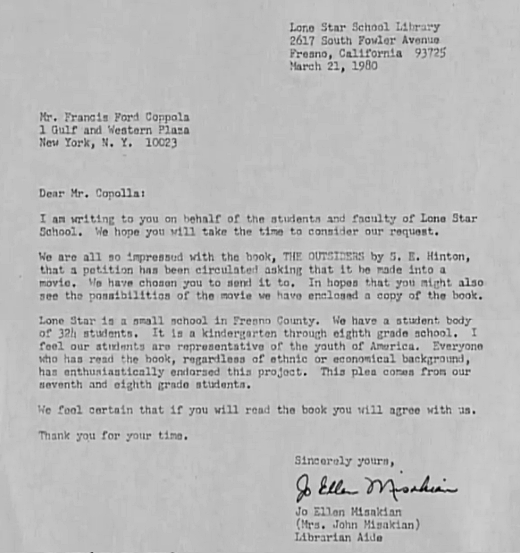
In middle school, one of my favorite books was The Outsiders by S.E. Hinton. I must have read it twenty times. Then I found a copy of the VHS and watched that repeatedly, too. There’s a lot of argument pitting books against their movie versions, and for The Outsiders I loved both. So it was awesome to see today’s Letters of Note, in which a school librarian and her students helped bring The Outsiders to Francis Ford Coppola, who ultimately directed the film. The first letter:

Click through to see the full exchange. It’s really heartwarming to see how one librarian aide’s letter helped create a fantastic movie. And it’s a great lesson in never doubting that your voice can make a difference. Maybe it won’t come to anything–but maybe it will.

(image via Letters of Note)

Becoming an Artist

A touching video in which children’s book author/illustrator Jarrett Krosoczka talks about how he became an artist.

“He liked making this book” might be the best line in any author bio I’ve ever seen. I also love how he talks about the support he got from his grandparents and his teachers. Even though writing/illustrating requires a lot of work and you have to power through a lot of challenges, as Krosoczka details, but having a wonderful support system can make all the difference. And I love that Krosoczka set up a scholarship in his grandparents’ honor. What a beautiful way to keep the support going.

(via SCBWI: The Blog)

Follow Your Characters

At writing group last weekend, my critique partners mentioned they liked my latest project but were wondering where it was going, exactly. “Me too!” I said (in more or less words). I know a lot of writers who like to outline everything and map out exactly where their characters are going, but that doesn’t really work for me. I’m more of a “write-by-the-seat-of-my-pants” kind of writer–I have a vague idea of where I’m going, but I don’t have a strict outline and write toward where the characters feel like they should be going. Which sometimes makes it difficult to create a real plot.

So of course I was psyched to see this hilarious comic from Jane Yolen and Mike Cavallaro about creating plot.

Make sure to click through for the rest. I especially like Yolen’s comment at the end: ““There are two kinds of writers—the ones who figure out a plot ahead of time before writing, and the ones who set their characters in motion and then run after them saying, “Hey. . .wait for me.”” The latter is definitely more like me. And it might take a little while to figure out exactly what’s going on and how it should all come together, but there’s something exciting about chasing after your characters and learning about what’s important to them.

Okay, in case you’re a pants-er like me and do want some plot guidance, here are some great suggestions for laying out a basic plot map.

(image: Mike Cavallaro and Jane Yolen, via Figment) (H/T Lauren M Barrett)

http://lizwritesbooks.com/2012/05/the-7-point-plot-system-aka-save-the-cat-for-pantsers/