Lessons Writers Can Learn from the 2026 Winter Olympics

The 2026 Olympics and Paralympics in Milan wrapped up a few weeks ago, which means I won’t have my emotional support athletes to make me happy cry on a daily basis. I’m not a big sports person–far from it!–but I love the Olympics. So many of the athletes are regular people in their non-Olympics lives, with non-sports jobs, and they only get this kind of media focus during the games. Largely, they’re not making a ton of money from their sport. They’re doing it because they love it and want to give it their all.

I always follow the figure skating because that’s a personal favorite, and this year was one of the best Olympics viewing experiences I can remember. It wasn’t because of the medal count or the scores. It was the people who made these Olympics meaningful.

Which brings me to today’s topic: lessons writers can learn from 2026 Winter Olympians.

You’re in Charge of Your Career

Alysa Liu was the big winner this year, but it came after a lot of struggle and stress and doubt. She’d been skating since she was five and had been extremely competitive as a young skater. She was obviously very talented and the figure skating culture around her encouraged training at the expense of rest and nourishment. She lacked control over her performances as a young skater and, even though she did extremely well in competition, she ended up burnt out and retired at 16.

When she decided to return to the ice, she knew she’d have to do things differently. She would listen to her body, including knowing how to fuel herself and how hard she needed to train and how much rest she needed as a result. She was active in putting together her own routines and embraced her unique style. All of that resulted in the most dynamic and exciting freeskate in the history of the world.
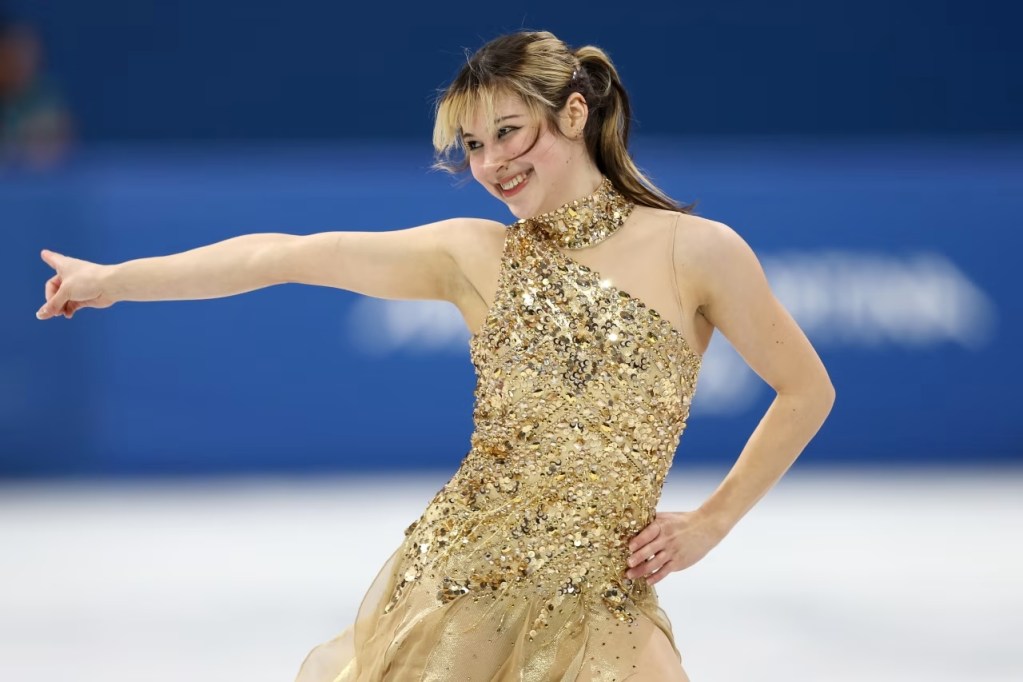
As writers, it can be easy to think there’s a ‘right’ path to success. If you only write in a buzzy genre. If you only post three new TikToks every day. If you only write even when you’re sick and you have work piled up from your day job and never complain. Success doesn’t have a ‘right’ path and if you keep trying to chase that hot genre or run yourself ragged, even if you manage to have a smash bestseller, you won’t be able to enjoy it because your heart wasn’t in it or because you’re too exhausted to care. Embrace your own Alysa Liu and a) respect your boundaries and health, and b) write the thing you feel deeply called to write, because that joy and meaning will shine through for readers.

Lift Each Other Up
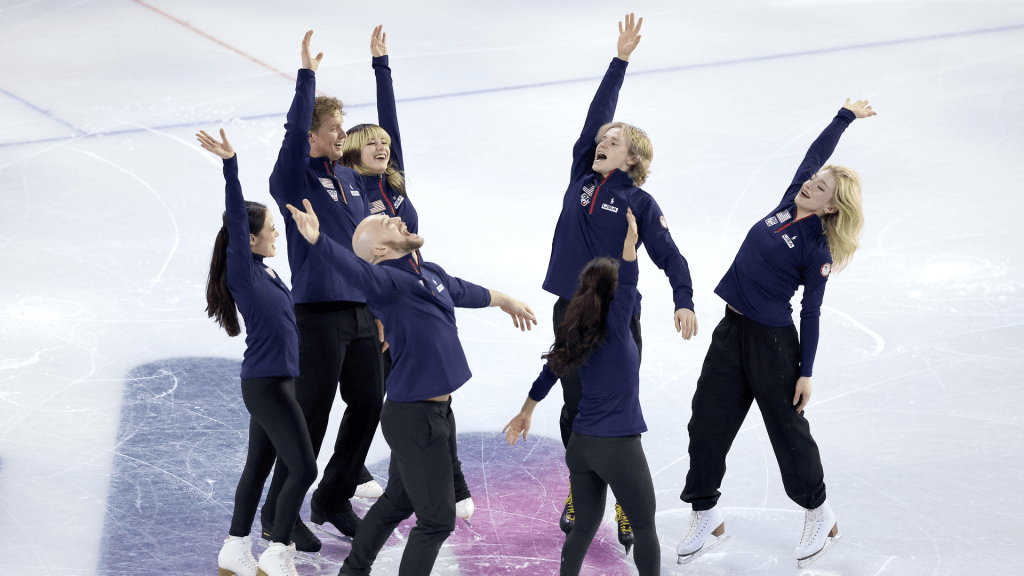
The standout feeling of figure skating at the 2026 Olympics didn’t have to do with “quad god” Ilia Malinin or Amber Glenn’s triple axels. Instead, it had to with the skaters themselves and how they approached the spirit of competition. it had to do with the supportive and joyful vibes that the skaters were bringing to the competition. They were all working hard and doing their best to win a gold medal, but they also saw each other as people, not just competitors.

From Amber Glenn blocking cameras so competitor Kaori Sakamoto could have a private, tearful moment to Ilia Malinin congratulating gold medalist Mikhail Shaidorov on his win after Malinin had an extremely tough program to Alysa Liu jumping up and down in joy with bronze medalist Ami Nakai to everyone surrounding Max Naumov with love after the loss of his parents, the energy in skating was all about how skaters can do their best individually and still support one another.

Whether you’re skating or writing, it’s very easy to get jealous of others’ success or think that you succeed alone. In a recent New York Times article about AI-generated romance novels, the generator was quoted as saying “‘If I can generate a book in a day, and you need six months to write a book, who’s going to win the race?'” Except writing isn’t a race. Someone else’s successful book doesn’t negate your book. Readers are going to want to read more than one book–likely, more than one kind of book. And if you’re approaching other authors like they’re just the competition, you’re missing out on a) seriously awesome friendships, b) connecting with other people who really get it, and c) having a valuable support system in this very difficult business of publishing. The authors who show up for other authors are my favorite.

Be Proud of the Medals You Get

Freestyle skier Eileen Gu became the most decorated female freeskier in Olympcis history when she won two new silver medals in Milan. After her win, a reporter asked whether she considered her new medals “two silvers gained or two golds lost.” Gu’s response was perfect:

“I’m the most decorated female freeskier in history. I think that’s an answer in and of itself… Winning a medal at the Olympics is a life-changing experience for every athlete. Doing it five times is exponentially harder, because every medal is equally hard for me, but everybody else’s expectations rise, right? So, the two medals lost situation, to be quite frank with you, I think, is kind of a ridiculous perspective to take. I’m showcasing my best skiing. I’m doing things that quite literally have never been done before, and so I think that is more than good enough, but thank you.”

I love the part about ‘everybody else’s expectations rise. In writing, it’s so easy to keep moving the bar for yourself. First you just want to finish a draft. Then revise it enough to feel confident querying. Then get an agent. Then get a book deal. Then a starred review. Then another book. Then a movie option. And on and on and on. It’s even harder when your professional circle is other writers–it’s easy to think that everyone writes a book or gets an agent or a book deal. But whether you have a bestselling book with a blockbuster movie or you just finished your first draft, you get to be proud of yourself. You achieved a big goal, one that most people don’t get to achieve. They all don’t have to be silver medals. You can enjoy every medal you get.


What I’ve Been Reading
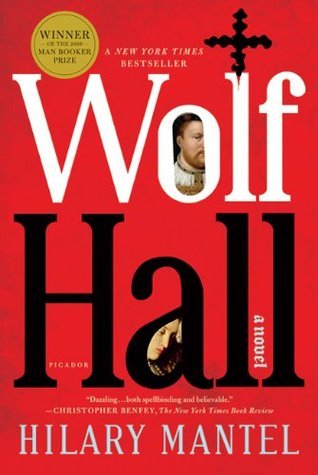
I recently finished Wolf Hall, which I picked up after watching the phenomenal miniseries on Masterpiece. The miniseries takes so much from the book and builds on the characters and situations even more, which was super satisfying.

I also finally got around to A Wizard’s Guide to Defensive Baking, which was a delight. I love T. Kingfisher’s books and this was the perfect blend of magic and sweetness.


Thoughts about your favorite Olympics moments? Other recent reads you’ve enjoyed? Share them in the comments!

Families Belong Together

If you’re like me, the news about immigrant families being separated and children being detained in horrifying conditions makes you ill to think about. This is a human rights violation happening on our watch. While I’m not an immigration lawyer or social worker, I can take a small part in this effort to reunify families and make sure these abuses never happen again.

Right now, in partnership with Kid Lit Says No Kids in Cages, the children’s and YA lit community has come together in a giant auction of tons of literary items, all raising money for groups such as the Refugee and Immigrant Center for Education and Legal Services (RAICES), Florence Immigrant and Refugee Rights Project, and more. Auction items include:

I’m taking part in two raffles–one that includes a signed copy of The Chance You Won’t Return and one that includes a query critique by yours truly.

See Writers for Families Belong Together for more information on how to donate and bid/enter raffles, and to scope out all the amazing items. This is an enormous, deeply upsetting problem and one we all need to address. I’m so glad to be taking part in this auction, and hope you take a moment to review the items. (Or donate in general!)

Writer Life Update – Agent News!

Exciting writer news to share! Over the last few months, I’ve been querying agents and looking for new representation. As I’m sure a lot of you know, querying is…a lot. It’s a lot of time trying to find agents who you think might like your stuff; a lot of time crafting your submissions and pitches; a lot of time waiting; a lot of rejection.

But. I have good news to share!

I’m now represented by the wonderful Laura Crockett at Triada US!!!

I’m so excited to be working with Laura. She’s super enthusiastic about my projects, has such a thoughtful approach to manuscripts and the market in general, and from our first conversation I got such a great vibe from her.

I need to put together a big post about my querying process soon, but I’m so happy that this news is now official. I’m psyched to be part of #TeamTriada and kick of 2018 with lots of new writing energy!

2018 Bookish Resolutions

The other day I looked at how I did with my 2017 bookish resolutions,.Today, let’s look at bookish resolutions for 2018.

Reading Resolutions

  1. Finish more book series that I’ve already started: I KNOW, I always have this one on the list. I’ve got a couple of series that I definitely want to get through, or make progress on. I will couch this by saying that there are also some series I’m meh about that I don’t have to return to, so no guilt there.
  2. Read more diversely: another resolution from last year that I’d like to continue. Making conscious choices to fill my reading list with writers of different backgrounds was really valuable for me as a reader, and I hope to do even more of this in 2018.
  3. Set aside more time to read before bed: it’s way too easy to futz on my computer or phone and not have enough time to read in bed, which is the coziest. I need to start getting ready for bed earlier and make sure I have that good reading time.
  4. Read more nonfiction: I started this in 2017 by accident, and have enjoyed listening to nonfiction audiobooks more than I anticipated. I’d like to make this a specific goal in 2018, especially if it combines with “read more diversely.”
  5. Read more fiction for adults: outside of nonfiction 95% of my reading is YA/MG. I’d like to get a few more titles for grown-ups in there, because it’s probably good to know what the grown-ups are reading, too.

Writing Resolutions

  1. Revise my current WIP: I’m starting on some more revisions for a WIP I’ve been working on for a while and really like. I’m hoping to get it in a really good place for early 2018.
  2. Start a new WIP: it’s been a weird time for me writing-wise, and I’m not sure what I want to work on next. I want to get in a place where I’m confident and excited about a new project, and can throw myself into it.
  3. Find the fun: again, it’s been a weird time. I want to find the joy in writing and to remind myself that I like spending time with my characters.
  4. Get off social media more: as much as I love the internets and honestly do love the bookish people I’ve met through Twitter, I need to take more of a step back from social media. It’s not good for my writerly soul at this point. (Outside of that–I do want to blog more. I feel like 2017 left me thinking “how can I blog about books when the world is so messed up?” But the awfulness of the state of the world doesn’t mean we can’t also enjoy the things we love.)
  5. Separate writing from publishing: the real big one for me this year. when I first started this list, I thought of resolutions like “get an agent” or “get a book deal” before I realized that those were not writing goals, those were publishing goals. And ultimately, those are out of my control. I need to remember that the writing is not the publishing. The only thing I have control over is the writing, and that’s the thing I like. Who knows how the rest of this is going to go, but at least I can keep writing.

Sending you all good reading and writing vibes for 2018, too. Let’s make this a year of strength and creativity and care.

2017 Bookish Resolution Recap

I’m going to spend the entirety of January writing “2017” on things before remember it’s 2018, so it seems like a great time to look at my 2017 reading/writing resolutions and my progress (or lack thereof).

  1. Finish more book series I’ve started: I have this on the list every year and made some minor progress toward finishing some book series that I’d started. I completed the entirety of Jenny Han’s To All the Boys I’ve Loved Before series, and the Tiffany Aching section of Discworld (a series that I’m already continuing into 2018).
  2. Read more diversely: I made a particular effort in 2017 to read authors of color and LGBTIQIA+ authors, which included some fantastic books.
  3. Listen to more audiobooks: I nailed this resolution! I ended up doing most of my reading via audiobook and am a major audiobook evangelical now.
  4. Explore more picture books: I didn’t do much on this end. Most of my reading comes from the library, and I feel a little weird scanning through the picture books without a particular purpose.
  5. Read more poetry: Yeah, didn’t do much on this end, either. I think I’ll be better off if I try to check out literary magazines for their poetry than devote myself to collections.
  6. Turn off the internet more: This ended up being more like ‘go to coffeeshops where you don’t know the wifi info’ than ‘turn off the internet more.’
  7. Write when I think I don’t have enough time: I did manage to sneak in some shorter writing time, and I think this is going to be especially helpful in 2018, when I have more non-writing job hours.
  8. Revise projects that aren’t finished: I revised a couple of projects and set another side for the time being. (I still like it, but it’s missing some major components and I just don’t know how to fix that yet.) I’m doing some additional revising on one of the projects now.
  9. Stretch my writing muscles: I didn’t end up being as stretchy as anticipated. For now I’m still solidly in the contemporary YA vein, which I like.
  10. Have fun: This one was probably the hardest goal, and one I’m still trying to manage. I’ve really questioned whether or not I can enjoy writing outside of publishing, and how I see myself as a writer without requiring other people externally validate that identity. But the writing itself–once I’m in it, it’s where I like to be. So it’s something I’ll need to keep addressing in 2018.

Did you make writerly/readerly resolutions in 2017? How did you do with them? Share in the comments, and be on the lookout for a future post about 2018 resolutions!

My Heart’s in Charlottesville

When I was preparing for a book event in Charlottesville last year, my mom said, “Your hometown!” It’s not where I was born or raised, and it’s not where I live, but it’s the home of my heart. I spent four wonderful years there while attending UVA, and go back every chance I get. It’s a special place in my life

So hearing about the violence and hate this weekend deeply hurt me. I was sickened to see white supremacists and Nazis waving torches on the steps of the Rotunda, to see the hate in their faces, and, worst of all, to see that people died and many others were injured as a result of this hatred.

Charlottesville isn’t a perfect place, but it’s the home of my heart. Right now, I’m feeling similar to how I felt after the Boston Marathon bombing–it’s an attack in a place I love, on values I hold dear.

My heart is with those who live in Charlottesville and saw their city shaken by bigotry, and the UVA students who will return to Grounds in this climate. I have faith that you all will stand firm on the side of love and justice and inclusion. Hate and violence have no place in the places we love, and it’s up to us to stand up for what’s right.

Writing While Anxious

In my session on writing about mental health at NESCBWI 17, I talked about some tropes/stereotypes I particularly disliked. One of them: that medication makes you an emotional zombie. This, and the idea that creative people with mental illness will lose their creativity through therapy/medication, get me super rage-y. If you have a mental health issue, medication can be a huge help, and the right medication/dosage won’t rob you of your creativity.

Which is why I was so happy to see this article about creativity, mental health, and medication in the New York Times.

Julia Fierro describes her experiences with obsessive-compulsive disorder, anxiety, and depression, and eventually finding medication and resources that work for her. But all of this care came after years of stress, and of going on and off medication, and how this has been a long journey to caring for herself as a person and as an artist.

One part in particular that stands out for me:

“Many of my favorite authors had suffered from anxiety or depression — Dostoyevsky, Fitzgerald, Plath, Woolf and Emily Dickinson…Surely, I told myself, their anguish was linked to their greatness. Instead of fleeing anxiety and depression (although many did douse their emotional instability with alcohol), they dived in and used their misery as inspiration for their creative work. I was convinced that killing the mad part of me with medication would also kill that which made me unique. I memorized a line by Proust: “Happiness is beneficial for the body, but it is grief that develops the powers of the mind.””

I feel like this is a pretty common assessment people make when it comes to creativity and mental health. For some reason we assume that if you want your brain to be firing on all creative cylinders, you need to embrace the parts of your brain that are bringing you down with depression, anxiety, bipolar disorder, etc. That creative people have to be mentally ill in order to be creative.

Which is total crap.

Like Fierro, I can’t write if I’m not taking care of my mental health. If I’m experiencing a bad bout of anxiety, I can’t focus on anything, much less muster the kind of focus that a draft requires. I can’t let myself spend time with my characters and their worlds, because I’m too busy worrying about what the publishing market is like, or if I should give up writing entirely because I’m the worst. When I’m anxious, I’m both way too hyped up and way too exhausted to be a creative person.

Thanks to therapy and medication, I can mostly write when I need and want to. (Getting myself off Twitter is another issue.) For me, creativity happens when my brain doesn’t have to deal with its own bad stuff. Maybe some artists don’t work well with medication, but that’s super not me, and that’s not what I know from most artistic friends who have mental health issues.

Fierro begins and ends her article by talking about how she shared the truth about her mental health struggles and successes with an audience at a reading. Fierro connected with her audience members by being honest, because some of them have been dealing with the same kinds of issues. At NESCBWI, I was so grateful that people in my session also opened up and talked about their own struggles and concerns. Because the more we talk about mental health and art, the more real we can be–and the more we know we’re not alone.

Kidlit for Cancer Research

This time next week, I’ll be running the Boston Marathon with the Dana-Farber team. I ran with Dana-Farner last year, too, and it was one of the best experiences I’ve ever had.

But for charity team runners like me, fundraising for a great cause is even more important than the race itself. On the Dana-Farber team, we raise money for innovative cancer research at the Claudia Adams Barr Program, where scientists use this seed money to fund creative and dynamic projects that could make major lifesaving changes for patients and families. I know way too many people whose lives have been affected by cancer in some way, and I’m so honored to be part of these efforts to support science and fight cancer.

Right now, you can help support science and fight cancer AND win some awesome writerly items. What more could you want? Check out Kidlit for Cancer Research, in which some fantastic writers and agents have donated signed books and query/first page critiques! There’s some seriously awesome stuff like:

The auction closes tonight, so get your bids in now! 100% of funds raised go to groundbreaking research at the Claudia Adams Barr Program in Innovative Basic Cancer Research at Dana-Farber Cancer Institute.

Going to the Dogs: a Lesson from Olly and the Crufts Dog Show

Recently, a friend and I were talking about the phrase “going to the dogs.” Humans’ relationship with dogs have changed in the last few centuries, and how we think of dogs as great companions. How can something “going to the dogs” still be a bad thing?

And if anyone can teach us about how to deal with the bad things, it’s dogs. Example: Olly the Terrier.

Olly didn’t have a great showing at the recent Crufts dog show–major fail right away, face plant right into the ground.

But Olly didn’t care.

He was “all over the place” after that and ran the wrong way through one of the challenges, but, as the announcer said, he was “having a ball.”

Olly knows a thing or two about how to handle failure.

Sometimes things don’t go as planned. Sometimes we don’t have the show we wanted. But that doesn’t mean getting upset or mad at ourselves or quitting. Instead, maybe that means we should find the joy in what we’re doing and go after that. Maybe we’re not going to win the dog show this year, but we’re going to have some fun while we’re there.

Failure is hard. Disappointment is hard. But no one can take that Olly-ish joy away from you when you’re doing something you love.

From now on, if something’s “going to the dogs,” respond like Olly the dog. Find your enthusiasm, find your confidence, and keep at it.